

Stainless Steel Alloy Selection: Matching Grade to Application Demands
Stainless Steel Alloy Selection: Matching Grade to Application Demands
Selecting the appropriate stainless steel alloy is rarely a matter of picking the highest-performing option. For industrial buyers, importers, OEMs, and fabricators, it’s about aligning material properties with functional requirements, environmental exposure, regulatory compliance, and downstream processing needs. With over 150 standardized stainless grades—and dozens commonly stocked—the decision must be grounded in technical trade-offs, not marketing claims.
This post outlines a practical, application-driven framework for alloy selection, focusing on three widely used families: austenitic (e.g., 304, 316), duplex (e.g., 2205), and ferritic (e.g., 430, 444). We exclude precipitation-hardening and specialty alloys unless explicitly relevant to high-volume industrial use.
1. Clarify the Primary Service Environment
Start with the operating environment—not the specification sheet. Ask:
- Is chloride exposure present (e.g., coastal air, de-icing salts, process brines)?
- Will the part contact food, pharmaceuticals, or aggressive cleaning agents?
- Is continuous elevated temperature expected (>400°C)?
- Are cyclic thermal or mechanical loads dominant?
For example, a municipal wastewater pump housing faces intermittent chloride exposure, abrasion, and moderate flow velocity. Grade 304 may suffice in dry indoor sections but will pit prematurely in wet, chlorinated zones. Here, 316 offers measurable improvement due to its 2–3% molybdenum content—but at ~20–25% higher raw material cost. In contrast, a food-grade conveyor frame operating under clean-in-place (CIP) conditions benefits more from the superior surface finish and weld corrosion resistance of 316L than from the higher strength of 2205—making 316L the technically and economically justified choice.
2. Evaluate Fabrication Requirements Early
Alloy choice directly impacts manufacturability. Austenitic grades (304, 316) offer excellent formability and weldability but are prone to work hardening during cold bending or deep drawing. Duplex steels like 2205 provide higher yield strength (≈450 MPa vs. ≈205 MPa for 304), reducing section thickness in pressure vessels—but require tighter control of heat input and interpass temperature during welding to avoid sigma phase formation.
Ferritic grades (430, 444) are magnetic, less expensive, and highly resistant to stress corrosion cracking—but have lower ductility and limited weldability beyond thin gauges. A fabricator producing large-diameter HVAC ducts may prefer 430 for its deep-drawing consistency and cost efficiency, while avoiding it for welded expansion joints where fatigue resistance is critical.
Always confirm with your supplier whether the mill-supplied condition (annealed, pickled, bright-annealed) supports your intended fabrication steps. For instance, cold-rolled 304 in 2B finish is standard for stamping, whereas hot-rolled 316 plate requires descaling before laser cutting to prevent slag adhesion.
3. Consider Long-Term Maintenance & Lifecycle Cost
Initial material cost is only one component of total cost of ownership. A 316 component may cost 30% more upfront than 304—but if it extends service life by 3× in a chemical dosing manifold, the ROI becomes clear. Conversely, specifying 2205 for a non-critical structural bracket exposed to indoor ambient air introduces unnecessary complexity: higher procurement lead times, stricter welder qualification, and no meaningful performance gain over 304.
Also factor in traceability and certification requirements. If ASME BPVC Section VIII or FDA 21 CFR Part 178 applies, ensure mill test reports include full chemistry, tensile data, and intergranular corrosion testing (e.g., ASTM A262 Practice E for sensitization assessment). Avoid generic “stainless” declarations—demand UNS numbers (e.g., S31603, S32205) and heat-specific certs.
4. Watch for Common Specification Pitfalls
- Over-specifying molybdenum: Adding Mo improves chloride resistance, but only up to a point. Beyond ~4% (as in super-austenitics), cost rises sharply without proportional gains for most industrial applications.
- Ignoring nitrogen content in duplex grades: Nitrogen enhances pitting resistance and stabilizes the austenite-ferrite balance. Verify minimum N content (e.g., ≥0.14% for 2205) in mill certs—not just Cr/Ni/Mo ranges.
- Assuming all ‘316’ is equal: Standard 316 contains up to 0.08% carbon; 316L caps carbon at 0.03% to resist sensitization. For welded components >3 mm thick, 316L is often mandatory—even if unlisted in the PO.
- Neglecting surface condition impact on corrosion: A 316 pipe with mill scale and embedded iron contamination will corrode faster than a properly pickled and passivated 304 pipe in the same environment.
Conclusion
Alloy selection is an engineering decision—not a procurement checkbox. Start with the service environment and fabrication sequence, then cross-reference mechanical, corrosion, and regulatory constraints against verified grade properties. Work closely with suppliers who provide UNS-specific inventory, mill-certified stock, and technical support for grade substitution validation. When you specify precisely, you reduce rework, avoid premature failure, and align material cost with real-world performance. For immediate support, contact our materials engineering team—we maintain live inventory data across 304, 316(L), 2205, 430, and 444, with full traceability back to melt heat.
Published 2026-05-24
¿Listo para abastecerte de acero inoxidable?
Habla con un fabricante que responde en 24 horas.
Obtén precio directo de fábrica, soporte de embalaje de exportación y orientación técnica para láminas, bobinas y tuberías.
Productos destacados
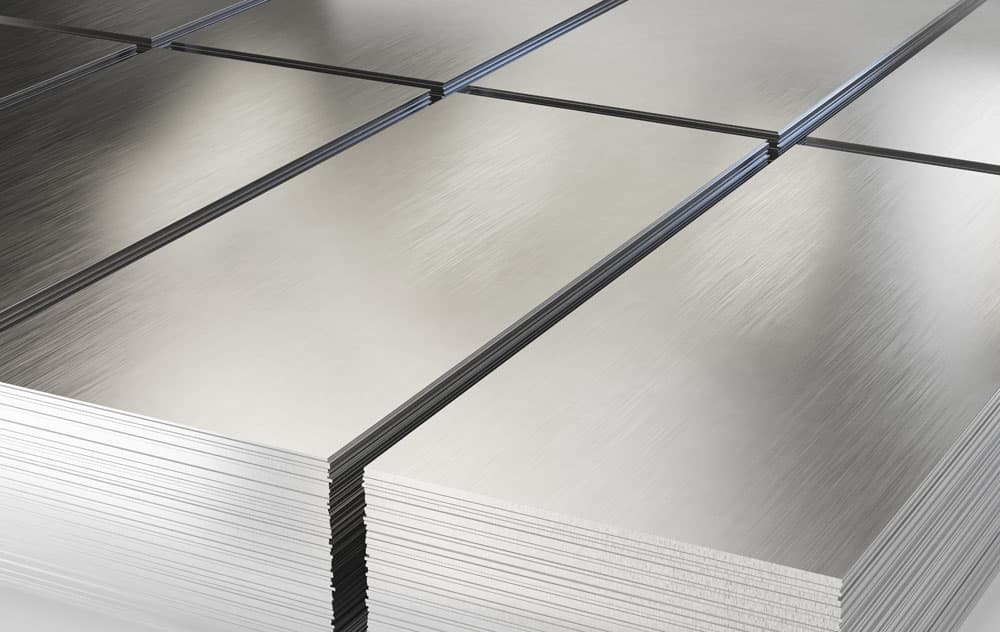
Lámina de acero inoxidable 304/304L
La aleación más versátil y utilizada. Excelente resistencia a la corrosión y formabilidad.
Bobina de acero inoxidable 316/316L
Grado con molibdeno y mayor resistencia a la corrosión en ambientes con cloruros.
Tubería redonda de acero inoxidable 201/304
Tubería redonda versátil en 201/304 con buena resistencia a la corrosión y formabilidad para usos estructurales y decorativos.