
Stainless Steel Surface Finishes: Selection for Function and Compliance
Why Surface Finish Matters Beyond Aesthetics
For industrial buyers, importers, and OEMs, stainless steel surface finish is rarely just about appearance—it directly influences corrosion resistance, cleanability, fatigue life, gasket seating, regulatory compliance (e.g., FDA, EHEDG, ASME BPE), and even downstream fabrication costs. Yet finish specifications are often underdefined in purchase orders or assumed based on legacy practice. This leads to mismatched material, rework, or non-conformance—especially in food processing, pharmaceutical, semiconductor, and high-purity fluid systems.
This post outlines key functional considerations when specifying finishes—not as a catalog of options, but as a decision framework aligned with real-world application demands.
1. Understanding the Standard Finish Designations
Stainless steel finishes follow ASTM A480/A480M and EN 10088-2 standards, but terminology varies across regions and suppliers. The most widely used mill finishes include:
- No. 1: Hot-rolled, annealed, and pickled. Rough, matte surface; typically used for industrial tanks or structural components where appearance isn’t critical.
- No. 2B: Cold-rolled, annealed, pickled, and lightly rolled. Smooth, reflective, and economical—the default for ~70% of flat-rolled stainless. Offers good corrosion resistance and forms well, but lacks the enhanced cleanability of brushed or polished finishes.
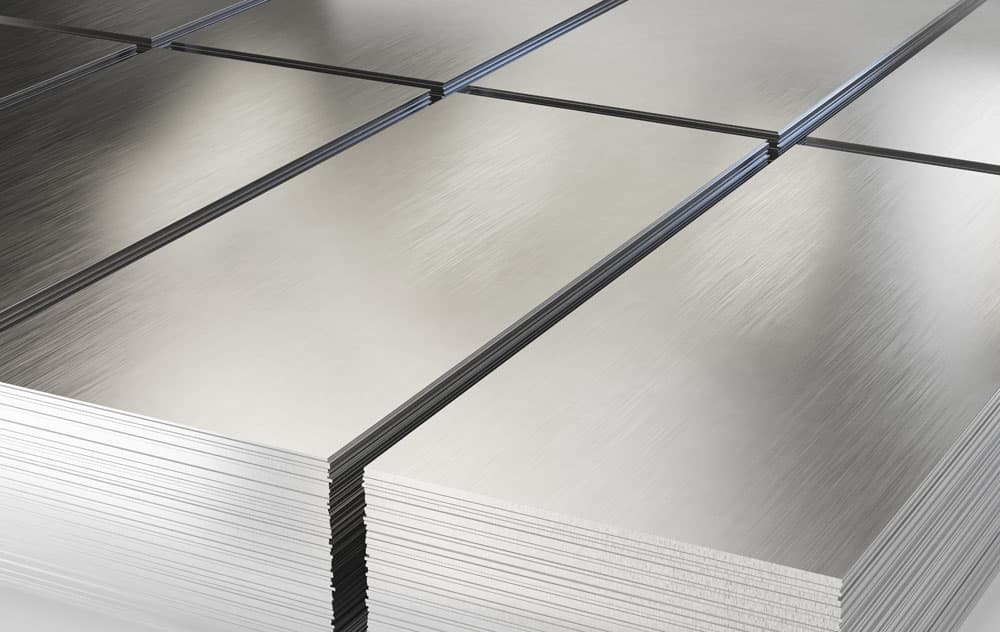
- No. 4: Linear grain finish produced by abrasive belt polishing (typically 120–180 grit). Common in architectural and food-grade equipment. Provides improved scratch hiding and directional texture that aids cleaning validation.
- HL (Hairline): A refined No. 4 variant with tighter, more uniform grain (often 240–320 grit). Used where consistent reflectivity and reduced glare matter—e.g., cleanroom casework or medical device enclosures.
- BA (Bright Annealed): Cold-rolled, hydrogen-annealed in a controlled atmosphere. Mirror-like, non-directional, and highly reflective. Offers superior corrosion resistance due to minimal surface disruption—but requires careful handling to avoid marring.
Note: Electropolishing is not a mill finish—it’s a post-fabrication process that removes surface iron, improves passive layer uniformity, and reduces Ra values. It’s often layered atop No. 2B or BA for high-integrity applications.
2. Matching Finish to Functional Requirements
Selecting a finish starts with defining the primary function:
-
Hygienic Integrity: In dairy, biopharma, or beverage lines, surfaces must resist microbial adhesion and allow validated cleaning (CIP/SIP). Studies show Ra ≤ 0.8 µm significantly reduces biofilm retention versus Ra > 1.2 µm. No. 4 finishes typically range from Ra 0.4–0.6 µm when properly executed, but grit consistency matters more than nominal grade—verify supplier test reports, not just labeling.
-
Fatigue and Stress Corrosion Resistance: Directional finishes like No. 4 introduce micro-notches aligned with tensile stress paths. For cyclic-loaded components (e.g., pump housings, agitator shafts), a non-directional BA or electropolished finish may extend service life by reducing initiation sites.
-
Gasket and Seal Compatibility: Flatness and surface roughness affect seal compression and leak rates. Soft elastomer gaskets perform best against Ra 0.2–0.5 µm surfaces. Over-polished BA (Ra < 0.1 µm) can reduce grip and increase blowout risk under thermal cycling.
-
Weld Integration: Mill finish and weld bead finish must be compatible. A No. 4 panel with unblended welds creates cleaning traps and visual discontinuity. Specify finish continuity requirements—including post-weld blending scope and Ra limits—in technical documentation.
3. Specifying and Verifying Finish Consistency
Ambiguous specs invite variation. Replace phrases like “brushed finish” or “mirror finish” with standardized references:
- Use ASTM A480 Table 1 or EN 10088-2 Annex A to define finish type, grit range, and Ra tolerance (e.g., “No. 4 finish per ASTM A480, 150 ±20 grit, Ra 0.45–0.55 µm measured per ISO 4287”).
- Require supplier-provided surface profilometry reports for lot acceptance—especially for lots destined for hygienic use.
- Clarify whether finish applies to all surfaces (including cut edges, holes, and internal features) or only exposed faces. Edge conditions often dominate failure modes.
Avoid assuming that a ‘No. 4’ label guarantees compliance—finish quality depends on belt condition, tension, feed rate, and operator skill. Reputable suppliers maintain documented process controls and provide traceable certification.
4. Cost and Lead Time Implications
Finishes impact both procurement and fabrication budgets:
- No. 2B carries no premium over base mill cost; it’s the benchmark.
- No. 4 adds ~8–15% to flat-rolled material cost—and up to 25% for narrow widths or small lots due to setup and throughput constraints.
- BA and electropolishing add 20–40%, plus 1–3 weeks lead time depending on capacity.
- Post-fabrication finishing (e.g., onsite brushing or EP of welded assemblies) often costs 2–3× more than mill-applied finishes and introduces variability.
Early collaboration with your supplier helps balance performance needs against total landed cost—including scrap from finish-related rework.
Conclusion
Stainless steel surface finish is an engineered feature—not decoration. Buyers and fabricators gain control by anchoring specifications to measurable parameters (grit, Ra, standard reference), validating against functional outcomes (cleanability, sealing, fatigue), and aligning expectations early with suppliers. When finish is defined precisely, it reduces inspection disputes, accelerates commissioning, and strengthens long-term asset reliability—especially where hygiene, safety, or precision are non-negotiable.
For immediate support selecting or verifying finishes for your next order, contact our technical sales team with your application details and required standards—we’ll provide finish recommendations backed by material certifications and surface metrology data.