

Stainless Steel Thickness Tolerances: What Fabricators Must Specify
Stainless Steel Thickness Tolerances: What Fabricators Must Specify
When sourcing stainless steel for precision fabrication—whether for pressure vessels, food-grade conveyors, or structural brackets—thickness is rarely just a number on a datasheet. It’s a critical dimensional parameter that affects weld integrity, load capacity, surface finish consistency, and compliance with engineering drawings. Yet it remains one of the most frequently under-specified requirements in purchase orders and RFQs.
This post clarifies how stainless steel thickness tolerances work, why they vary by production method and specification, and what fabricators and OEM buyers need to specify—before placing an order—to avoid downstream cost overruns and schedule risk.
Why Thickness Tolerance Matters Beyond the Mill Certificate
A mill certificate confirms nominal thickness and chemistry—but not actual as-rolled or as-processed thickness. In practice, stainless steel plate, sheet, and coil are subject to inherent process variation. For example:
- Hot-rolled 304 plate (6 mm thick) per ASTM A240 typically carries a tolerance of ±0.18 mm.
- Cold-rolled 316 sheet (1.5 mm thick) per ASTM A480 may range from −0.05 mm to +0.07 mm.
- Laser-cut blanks from the same coil can show local variations up to ±0.03 mm due to residual stress relief.
These ranges seem small—but when assembling multi-part assemblies with tight fit tolerances (e.g., gasketed flanges or nested brackets), cumulative deviation can prevent proper bolt alignment or cause interference during welding prep. Worse, if your design assumes a minimum thickness for corrosion allowance or fatigue life—and the delivered material falls at the lower end of the tolerance band—you risk non-compliance with ASME BPVC Section VIII or FDA 21 CFR Part 110.
How Production Method Drives Tolerance Variation
Thickness control depends heavily on how the material was produced:
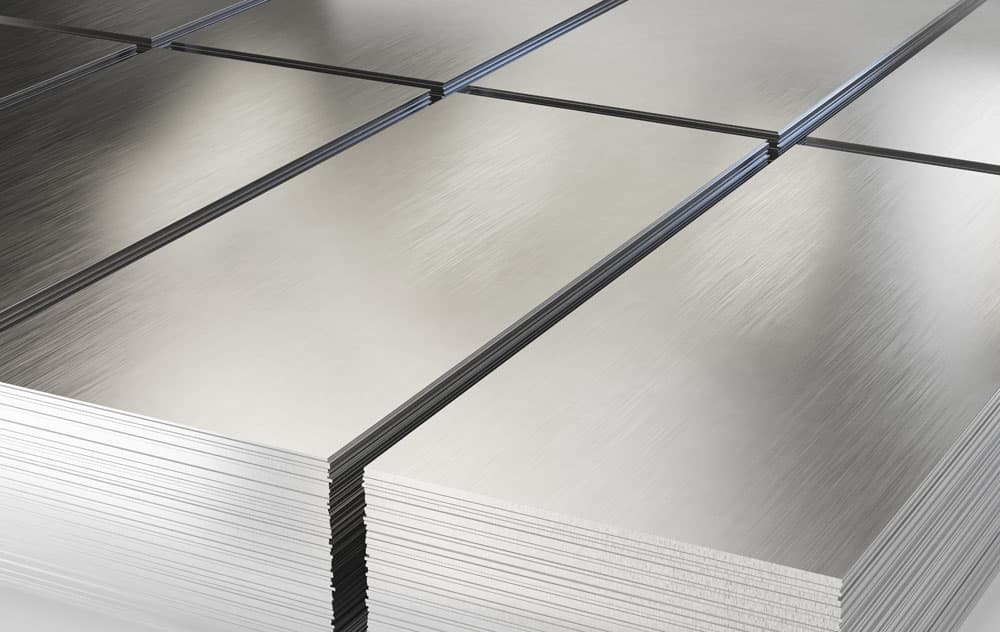
Hot-rolled products (plate, wide strip) have wider tolerances due to scale formation, thermal contraction, and roll deflection at high temperatures. ASTM A240 permits broader bands—especially above 10 mm thickness—where tolerances widen proportionally.
Cold-rolled products, by contrast, undergo tension leveling and multiple pass reductions at room temperature. This yields tighter thickness consistency, particularly in thinner gauges (<3 mm). However, cold rolling also introduces coil memory and edge wave—so thickness across width isn’t uniform. A 1200 mm-wide coil may measure 1.98 mm at center and 2.02 mm near edges—even within spec.
Tempered or skin-passed material adds another layer: light reduction after annealing improves flatness but can compress surface layers, slightly reducing measured thickness versus the base gauge. Buyers specifying “temper rolled” must confirm whether tolerances apply pre- or post-temper.
Key Standards and Where to Look
Always reference the applicable product standard—not just the grade. Common ones include:
- ASTM A240: Covers plate, sheet, and strip. Table X1.1 defines thickness tolerances by thickness range and processing method (hot- or cold-rolled).
- EN 10088-2: European standard with comparable but not identical tolerance tables; note that EN uses ‘nominal thickness’ differently than ASTM—verify definitions in Clause 8.
- JIS G4304: Japanese standard with tighter default tolerances for certain cold-rolled grades; often cited in automotive supplier specs.
Crucially, tolerance class matters. ASTM A480 defines classes such as ‘Precision’ (tighter) and ‘Commercial’ (standard). Unless specified, suppliers default to Commercial. Precision class adds ~8–12% cost but cuts thickness variation by up to 50%.
What to Specify—And What to Avoid
Effective specification starts with clarity—not assumptions. Include these four elements in every stainless steel purchase order or technical data package:
- Nominal thickness + tolerance class (e.g., “2.0 mm ±0.06 mm, ASTM A480 Precision Class”). Avoid vague phrasing like “approx. 2 mm” or “2 mm typical.”
- Measurement location: Specify whether tolerance applies to centerline, average across width, or minimum point (critical for load-bearing parts). EN standards often require min-thickness verification; ASTM allows averaging unless otherwise noted.
- Flatness requirement (if relevant): Thickness and flatness interact. A part requiring ≤1 mm/m flatness may need tighter thickness control to prevent localized thinning during leveling.
- Verification method: State whether thickness will be verified via ultrasonic gauge (for plate >6 mm) or mechanical micrometer (for sheet <3 mm)—and whether results must be reported per heat/lot.
Avoid conflating thickness tolerance with surface finish or edge condition. A #2B finish doesn’t guarantee tighter thickness control; likewise, slit edge tolerance (±0.2 mm) is independent of thickness tolerance.
Practical Steps for Your Next Order
- Audit recent fabrication issues: Track how many fit-up reworks or weld porosity incidents correlated with incoming thickness variation. Even anecdotal trends justify tighter specs.
- Collaborate early with your supplier: Share your critical dimensions and assembly sequence. Reputable mills and service centers can advise on achievable tolerances—and flag trade-offs (e.g., longer lead time for Precision Class).
- Validate incoming material: Use calibrated, traceable tools—not shop-floor calipers older than calibration due date. Record min/max readings across three locations per sheet.
- Update internal specs: Add a dedicated ‘Dimensional Requirements’ section to your stainless steel material specifications—separate from chemistry or finish.
Conclusion
Thickness tolerance is not a detail—it’s a functional requirement. Specifying it clearly reduces scrap, accelerates first-article approval, and strengthens supply chain predictability. The cost of tighter tolerances is modest compared to the cost of rework, delayed shipments, or field failure. Start with one high-impact part family, define thickness requirements precisely, and scale from there. When your next RFQ includes unambiguous thickness language, you’re no longer just buying metal—you’re procuring dimensional reliability.
Published 2026-05-14.